
Synopsis
This article (published by Memoria Press) makes a strong case for classical education. The author suggests students learn excellence best by studying and imitating excellent models.
The author illustrates this principle through examples from the arts, noting Pablo Picasso. Known for his innovative and unconventional style, Picasso first learned to paint by copying the masters in the Louvre. Likewise, classical architect Allan Greenberg described how his architectural training required students to create detailed drawings of great buildings. This enabled them to internalize a “vocabulary” of architectural excellence.
Arguing that the same principle applies to education, the author makes a case for classical education.
Classical schools expose students to great literature, art, music, and ideas to provide models of what is true, good, and beautiful. By reading great books, studying masterful works of art, and listening to beautiful music, students develop an understanding of quality, virtue, and excellence.
Over time, these examples shape their imaginations and equip them to think, write, create, and communicate with wisdom and skill. The goal is not merely imitation. It’s to help form students who can build upon a rich tradition and ultimately contribute something meaningful of their own.
For these, and many other reasons, Adolesco Prep fully embraces the Classical Education Model.
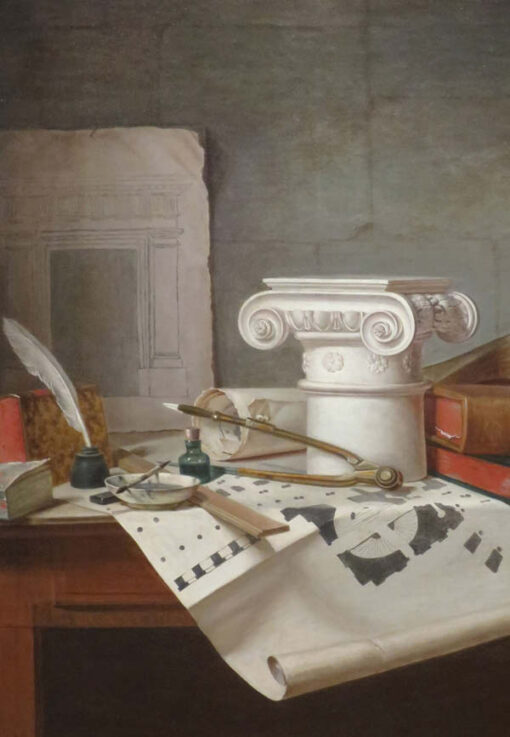
Every great artist knows that the highest aspiration of art is beauty and that the best means to this end is the imitation of beautiful things. Modern art is, of course, plagued with the idea that the goal of art is novelty or “self-expression” or social change or shock value, but even the best of modern artists recognize, at least implicitly, the value of imitation in the approximation of the beautiful.
Every artistic rendering of something is an artistic rendering of something. Even an artist as iconoclastic as Picasso, famous for breaking a lot of the rules of traditional painting in his co-invention of Cubism, learned how to paint in the first place by going to the Louvre, setting up his easel, and copying the masters.
Innovation, if it is to be done well, first requires an immersion in and imitation of tradition.
Several years ago The American Enterprise magazine conducted an interview with Allan Greenberg, a classical architect. It was an interesting discussion on how he approached his craft. One of the things he noted was the uninspired nature of much modern architecture, and he contrasted it with the greatness of buildings designed and constructed in former times.
Greenberg explained his experience attending the University of Witwatersrand in South Africa and how he was taught the principles of architecture:
We studied the history of architecture by the comparative method, where you do measured drawings, to scale, of great buildings. So at the end of five and a half years of schooling, you had a vocabulary of 100 buildings which you knew by heart, by dimension. The great buildings of architectural history were mixed into one’s architectural brain cells.
Note the central assumption behind this approach: You learn how to build great buildings yourself by first learning and imitating great buildings. This is a principle we need to remember when considering how we approach education.
People new to classical education will often ask why we read so much classic literature, or why we study great paintings or have students listen to great music. The first reason we do this is so that our children will know what good writing is, what good thought is possible, what good art consists of, and what a good song sounds like. The second reason is so that they can learn how to do these things themselves, having built for themselves a vocabulary of great examples.
Too often, we think we can teach children how to do something—read, write, paint, sing—by simply teaching them certain set techniques that they can practice without any concept of what the real purpose is. Sometimes this is necessary, particularly with younger children, but as we go along in the educational process, the great reading, the great writing, and the great art that they have studied all along will have developed within them a picture of what is possible, and then the techniques will be seen as mere means to Good and Beautiful ends.